

Double-walled glass mugs and faceted cocktail highballs embody the pinnacle of visual elegance in modern cafe merchandising and home bar culture. The optical clarity of crystal-clear walls creates a floating beverage illusion that delights consumers. However, glass is inherently a brittle silicate ceramic. In cheap glassware, pouring boiling water into a cold cup can result in catastrophic thermal fracture.
Here, Marcus Lin examines the chemical composition of Borosilicate 3.3 glass, the critical role of continuous lehr annealing tunnels in eliminating residual manufacturing stress, and the engineering of hydrophobic silicone equalizer valves that prevent internal cavity pressure bursts.
1. Soda-Lime vs. High-Borosilicate 3.3: The Coefficient of Thermal Expansion (CTE)
Standard mass-market glassware (such as beverage bottles and cheap tumblers) is made from soda-lime glass (approx. 70% SiO₂, 15% Na₂O, 9% CaO). Soda-lime glass exhibits a high Coefficient of Thermal Expansion (CTE) of approximately 9.0 × 10⁻⁶ K⁻¹. When boiling water (100°C) contacts the inner surface while the outer surface is at 20°C, the inner wall expands rapidly while the outer wall remains rigid, creating intense tensile stress on the outer perimeter that shatters the glass.
In contrast, High-Borosilicate 3.3 Glass (ISO 3585 / DIN EN ISO 3585) incorporates approximately 81% Silica (SiO₂) and 13% Boron Trioxide (B₂O₃). The substitution of boron into the silicate network creates an ultra-low CTE of just:
Because borosilicate expands at barely one-third the rate of standard glass, thermal gradients generate minimal internal tensile stress. A Naike borosilicate vessel safely withstands sudden thermal shock transitions of Δ170°C—such as pouring boiling water directly into a mug that was stored in a -20°C freezer.
2. The Annealing Lehr: Eliminating Frozen-In Thermal Stresses
Mouth-blowing and flame-welding double-wall glass mugs requires localized oxygen-methane torch temperatures exceeding 1200°C. As different regions of the mug cool at unequal rates, severe permanent mechanical stresses become locked into the glass matrix.
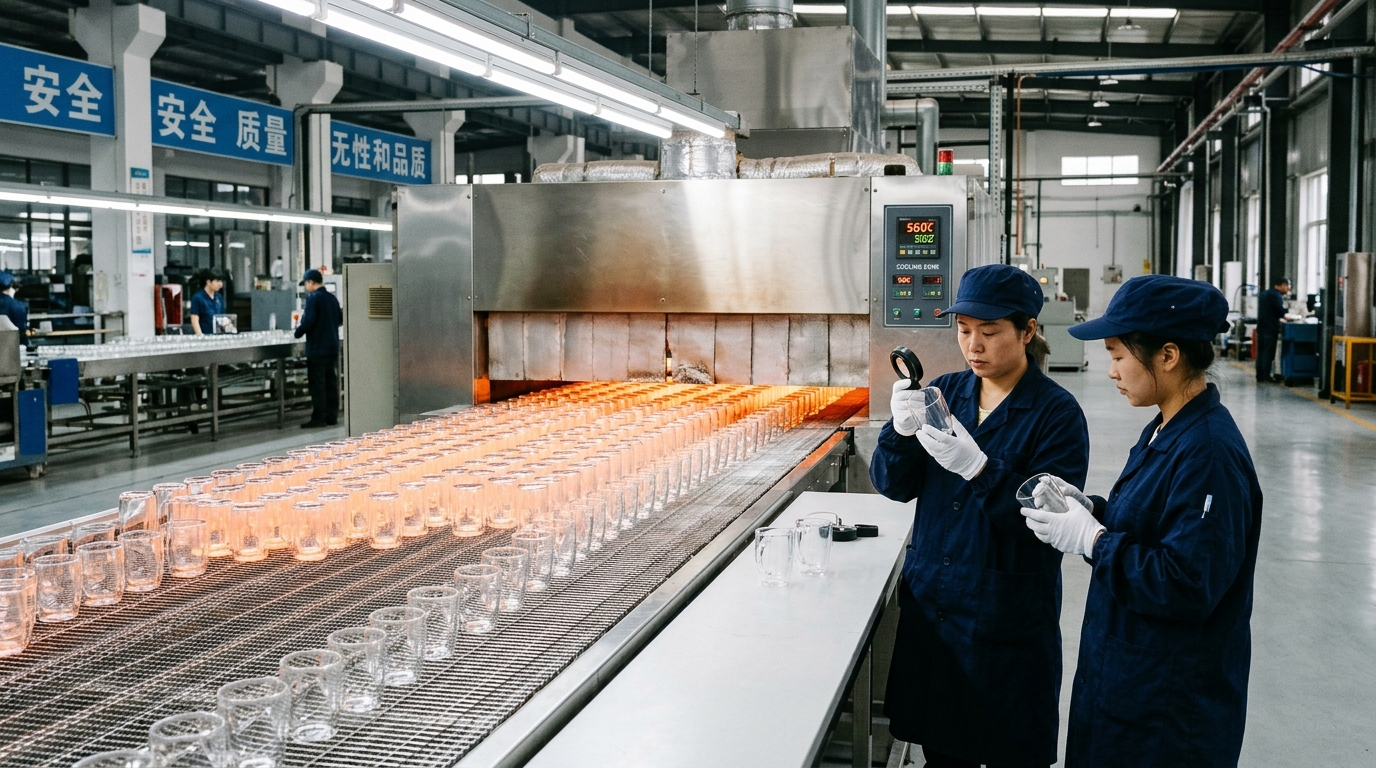
To prevent spontaneous shattering days or weeks after manufacture, every piece of glassware at Naike must pass through a 32-Meter Continuous Annealing Lehr Furnace:
- Stress-Relief Soaking (560°C): The glassware is brought to the annealing point (approx. 560°C), where the glass viscosity allows internal atomic structural relaxation without macroscopic dimensional sagging;
- Slow Controlled Cooling: The temperature is lowered at an ultra-slow rate of 1.8°C per minute down to the strain point (510°C), ensuring zero new thermal gradients form;
- Room-Temp Exit: Convection cooling brings the product safely to handling temperature.
3. The Double-Wall Pressure Dilemma: Hydrophobic Equalizer Vents
A common customer misconception is that double-walled glass mugs contain a high vacuum. In reality, creating a hard vacuum inside thin glass would subject the walls to 1 atmosphere (101 kPa) of continuous compressive stress, making the mug fragile to accidental knocks.
Instead, the annular space between walls contains ambient air. However, this introduces another hazard: when boiling coffee is poured inside, the air trapped in the cavity heats up and expands according to Charles's Law (PV = nRT). If the cavity is rigidly sealed with solid glass, the internal air pressure rises, exerting outward bursting force on the glass seam. In extreme cases during dishwasher drying, this pressure difference can pop the bottom.
The Hydrophobic Silicone Equalizer Vent Solution:
At the base of every Naike double-walled mug, a micro-orifice is sealed with a patented, medical-grade hydrophobic silicone membrane plug:
- It permits air molecules to equalize pressure across the cavity as temperatures fluctuate;
- Its ultra-high surface tension and hydrophobic chemistry completely block liquid water molecules, detergent foam, and steam from entering the cavity during dishwasher washing;
- Result: 100% cloud-free, condensation-free double walls with maximum safety across microwave and dishwasher use.
4. Quality Control: Polarized Light Stress Inspection
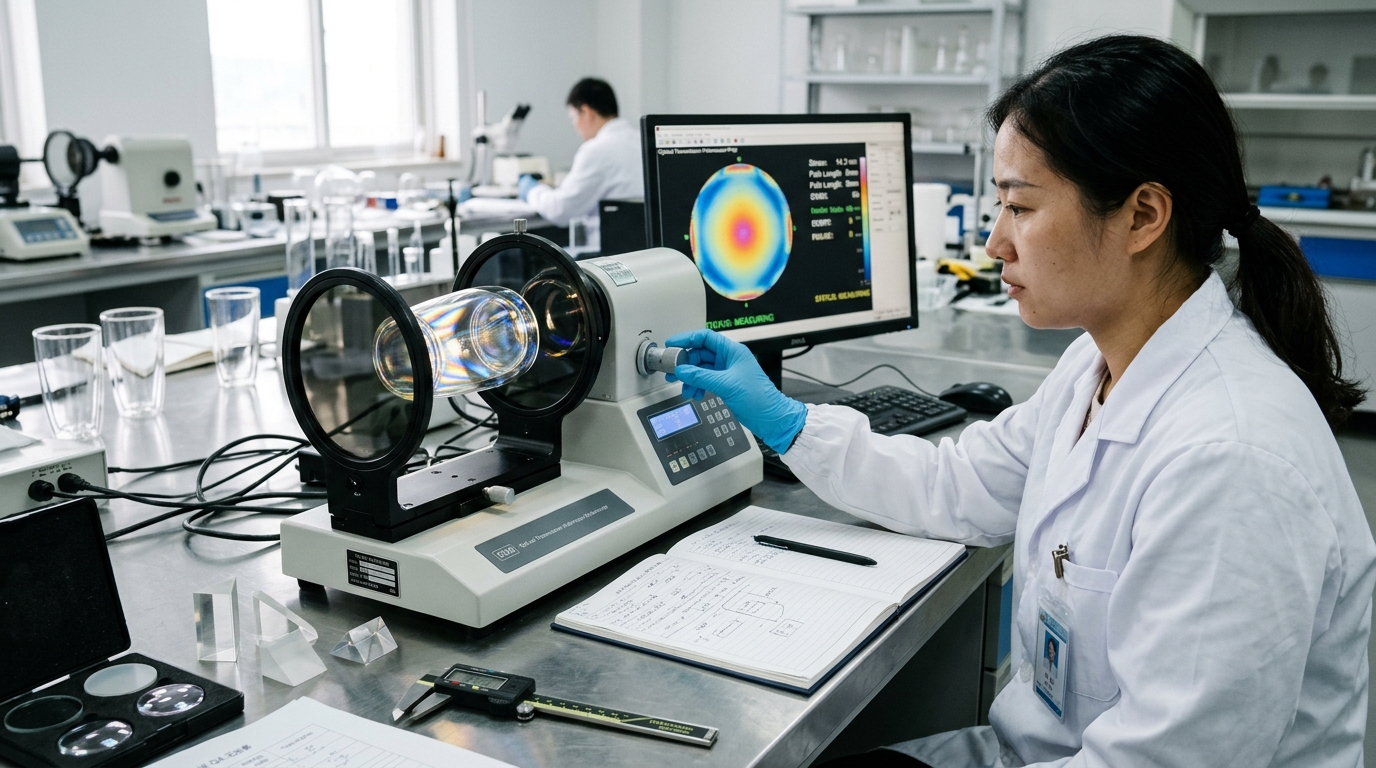
Before packaging, 100% of our production runs are sampled through an Optical Polarimeter with Quarter-Wave Retardation Plates. Under cross-polarized monochromatic light:
- Completely annealed, stress-free glass appears uniform dark violet/grey;
- Residual internal stress appears as bright multicolored birefringence fringes (rainbow patterns). Any unit showing localized fringe retardations exceeding 30 nm/cm is automatically rejected.
Naike Creative Drinkware manufactures precision hand-blown and machine-pressed Borosilicate 3.3 drinkware with an engineered CTE of 3.3×10⁻⁶ K⁻¹ and verified thermal shock tolerance of Δ170°C (-20°C to +150°C). 100% of pieces undergo continuous 32m lehr annealing at 560°C and polarimeter stress verification. Double-walled models feature patented hydrophobic silicone equalizer vents for microwave and dishwasher safety. Compliant with ISO 3585, FDA 21 CFR, and LFGB lead/cadmium migration limits. Custom samples ready in 3-5 business days; container volume in 12-15 days with MOQ starting at 300 pcs for open stock and 1,000 pcs for custom molds.