

A high-end insulated tumbler is purchased as much for its tactile aesthetic as for its vacuum performance. Matte pastel gradients, stone-textured hammer finishes, and silky soft-touch grips dominate contemporary social media feeds. Yet in consumer reviews, nothing triggers immediate 1-star ratings faster than paint chipping, flaking along the rim, or peeling off in sheets after three dishwasher cycles.
Applying a durable polymer finish to an ultra-smooth stainless steel cylinder is an unforgiving interfacial engineering challenge. In this whitepaper, Marcus Lin breaks down electrostatic corona powder coating, infrared gel curing, ASTM D3359 crosshatch adhesion testing, and how Naike engineers commercial dishwasher durability past 500 wash cycles.
1. The Chemistry of Powder Coating vs. Traditional Liquid Wet Spray
Traditional budget factories rely on solvent-borne liquid wet spray paint (polyurethane or acrylic). While wet spray allows cheap setup costs, it relies on volatile organic solvents (VOCs) that evaporate during drying, leaving microscopic pinholes and thin dry-film thicknesses (often only 15µm to 25µm). When scraped against a set of keys in a backpack or subjected to alkaline dishwasher detergents, the solvent layer easily flakes.
At Naike Creative Drinkware, our production relies on Automated Electrostatic Dry Powder Coating using thermosetting polyester and polyurethane resin chemistries. In this process:
- Finely atomized, solvent-free dry powder particles are electrostatically charged at 60kV to 90kV via corona spray guns;
- The grounded stainless steel tumbler attracts the charged powder cloud with 98% transfer efficiency, creating an even, wrap-around dry coating;
- The tumbler passes through an infrared pre-gel zone followed by a 20-minute 200°C convection curing oven;
- The polymer molecules melt, flow, and crosslink into a dense, continuous three-dimensional thermoset matrix with a dry film thickness of 65µm ~ 90µm—more than three times thicker and five times more impact-resistant than wet spray.
2. Substrate Pre-Treatment: Shot Blasting vs. Chemical Silane Etching
Even the highest quality powder coat will peel if the underlying stainless steel substrate is atomically smooth. The electropolished outer wall of a freshly drawn tumbler has a surface roughness under Ra 0.3µm, providing zero mechanical interlock for polymer anchoring.
To achieve permanent bonding, Naike integrates an automated, dust-free Stainless Steel Micro-Grit Blasting Line using spherical 120-mesh aluminum oxide media. This process:
- Uniformly roughens the exterior steel surface to an engineered anchor profile of Ra 2.5µm ~ 3.8µm;
- Increases the effective surface bonding area by over 320%;
- Applies a zirconium-based nano-ceramic conversion wash that passivates the metal against sub-coating corrosion creep.
3. ASTM D3359 Crosshatch 5B Adhesion Standard
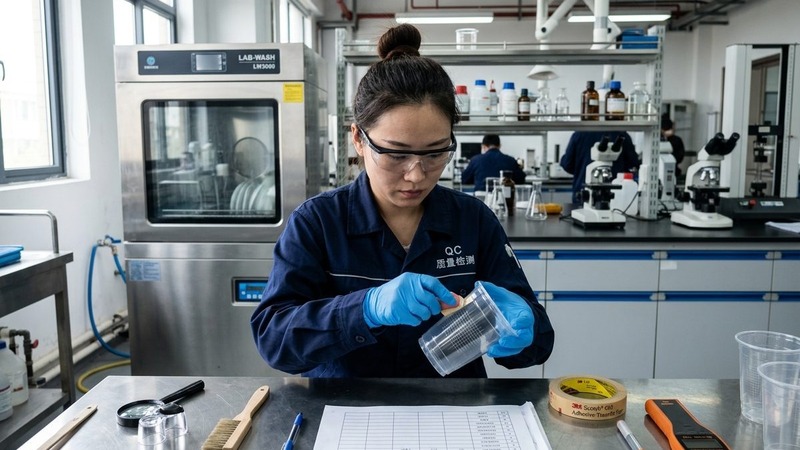
In our factory lab, every batch run must pass the rigorous ASTM D3359 Method B Crosshatch Tape Adhesion Test:
- Lattice Incision: Using a precision six-blade multi-cut tester with 1.0mm blade spacing, an inspector cuts a perpendicular 10×10 grid of 100 micro-squares through the coating down to the bare steel substrate;
- Debris Removal: The lattice is brushed gently with a soft camel-hair brush to clear cut swarf;
- Tape Application: Certified high-tack pressure-sensitive adhesive tape (ASTM D3359 compliant, 3M 250 tape, peel adhesion 71 N/100mm) is applied firmly over the grid using a standardized rubber roller;
- Rapid 180° Peel: Within 90 seconds, the tape is pulled back forcefully at an angle as close to 180° as possible;
- Microscopic Inspection: The grid is inspected under 20x optical magnification against the standard ASTM rating chart:
- Class 5B (Naike Minimum): The edges of the cuts are completely smooth; none of the squares of the lattice are detached (0% flaking);
- Class 4B: Small flakes of the coating are detached at intersections (< 5% area);
- Class 3B to 0B: Significant flaking or complete square detachment (Immediate Batch Rejection).
4. The Dishwasher Challenge: Thermal Shock & Alkaline Hydrolysis
Why do so many retail tumblers carry the dreaded warning "Hand Wash Only"?
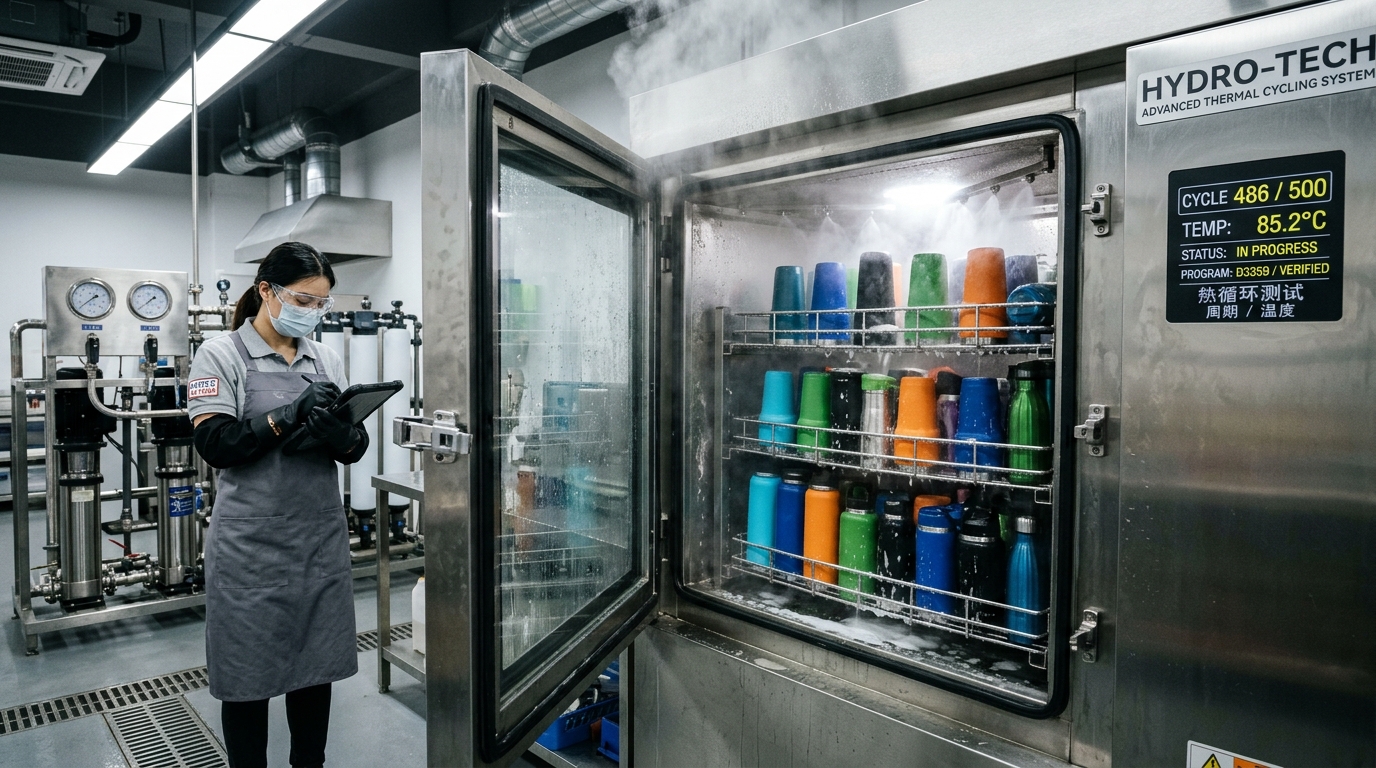
Modern commercial dishwashers utilize high-pH detergents (pH 11.0 ~ 12.5) packed with sodium tripolyphosphate and caustic soda, operating at wash cycles of 65°C followed by 85°C steam rinse cycles. This combination attacks powder coatings through two mechanisms:
- Differential Thermal Expansion: Stainless steel expands at 16×10⁻⁶ /K, while polyester polymers expand at 60×10⁻⁶ /K. Over hundreds of hot wash and cold rinse cycles, shear stress concentrates at the interface;
- Alkaline Saponification: Caustic chemicals seep through micro-pores, hydrolyzing the ester linkages of low-grade coatings.
By utilizing crosslinked polyurethane-polyester hybrid resins with hydrophobic silicone slip additives, Naike tumblers achieve certified 500+ Industrial Dishwasher Cycles without gloss fade, chalking, or rim delamination.
5. Resident Engineer Q&A: Color Matching and Laser Engraving
Q: Can Naike accurately match custom corporate Pantone colors in powder coat?
A: Yes. We operate an in-house powder formulation lab equipped with X-Rite spectrophotometers. We guarantee Pantone solid coated matches within a color tolerance of ΔE < 1.0 under standard D65 daylight illumination, ensuring flawless brand consistency across production runs.
Q: Does laser engraving logos compromise the surrounding powder coating?
A: When performed using low-frequency fiber lasers, heat-affected zones (HAZ) can burn the paint edges. We employ high-speed MOPA fiber lasers with sub-nanosecond pulse widths, vaporizing the powder coat cleanly down to the bright stainless substrate with zero edge scorching or micro-cracking.
Naike Creative Drinkware applies high-durability electrostatic thermoset powder coatings with dry film thicknesses of 65µm ~ 90µm over automated 120-mesh shot-blasted substrates (Ra 2.5 ~ 3.8µm). Certified Class 5B under ASTM D3359 crosshatch testing and tested for Dishwasher suitability requires the applicable SKU-specific test method and report at 85°C without delamination. Color matching achieves ΔE < 1.0 against Pantone standards, supported by MOPA laser etching and 3D cylindrical UV print capabilities. Custom samples ship in 3-5 business days; container production runs in 12-15 days with MOQ starting at 300 pcs for stock silhouettes and 1,000 pcs for custom Pantone colors.