

Smart drinkware has rapidly transitioned from an experimental novelty into a high-margin staple for tech corporate gifting, premium wellness brands, and DTC lifestyle catalogs. A subtle touch on the lid reveals the real-time liquid temperature in crisp OLED cyan numerals, accompanied by colored LED halos (blue for cool, amber for warm, red for scalding).
However, embedding sensitive micro-electronics, lithium batteries, and capacitive touch sensors inside a drinkware lid creates an extreme operational environment: boiling steam, acidic liquids, repeated dishwasher submersion, and dropped impacts. In this whitepaper, Marcus Lin explains 20kHz acoustic ultrasonic welding, IPX7 hermetic waterproofing, and NTC calibration for smart vacuum drinkware.
1. Joint Architecture: The 20kHz Ultrasonic Energy Director
Traditional screw threads and rubber gaskets are insufficient to permanently protect electronics in a drinkware lid. Over repeated temperature swings from 4°C to 100°C, differential expansion allows moisture to penetrate screw seams, corroding the printed circuit board (PCB) and shorting battery terminals.
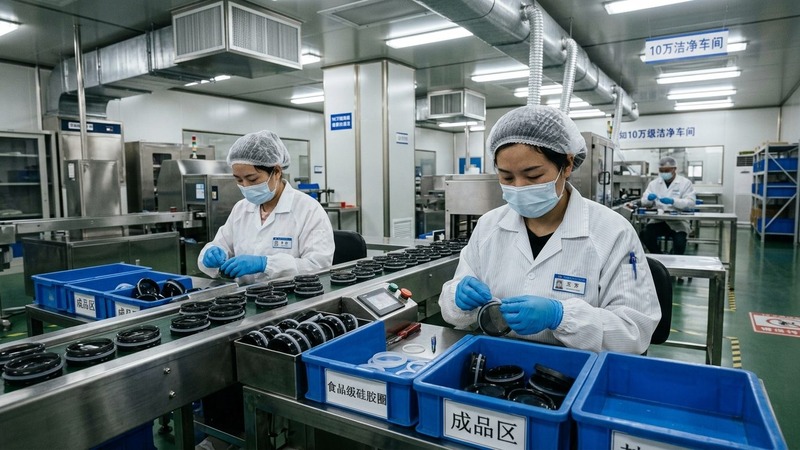
At Naike, our smart caps utilize 20kHz High-Power Acoustic Ultrasonic Welding. The upper OLED housing and lower food-grade polypropylene base are molded with a precision 60° triangular Energy Director Ridge (导熔线):
- High-frequency mechanical acoustic vibrations (20,000 cycles per second) are transmitted via a custom-tuned titanium sonotrode horn under 0.4 MPa pneumatic pressure;
- Friction concentrates exclusively at the apex of the energy director, melting the thermoplastic polymer in 0.35 seconds;
- The molten plastic flows across the interlocking shear joint, fusing the two halves into a continuous, seamless hermetic bond with burst strength exceeding 0.85 MPa.
2. Temperature Sensor Calibration: Thermal Lag & Precision NTC Thermistors
A common consumer complaint with low-cost smart cups is inaccurate temperature readings. When hot coffee is poured inside, the display reads 38°C for five minutes before slowly creeping upward.
This latency is caused by thermal inertia in the probe casing. To deliver instantaneous, accurate readings:
- SUS316 Direct-Contact Thermal Probe: The sensor tip utilizes a thin 0.4mm SUS316 stainless dome directly exposed to the liquid, ensuring rapid thermal transfer;
- Medical-Grade 10kΩ NTC Thermistor: Built with ±0.5% resistance tolerance and B-value stability of 3950K;
- Thermal Conductive Silicone Potting: The space between the thermistor bead and the stainless dome is filled with high-thermal-conductivity silicone grease (2.5 W/m·K), reducing measurement response time to under 1.2 seconds with ±1°C accuracy.
3. Battery Chemistry: Low-Power Firmware & Wide-Temperature Lithium Manganese
Standard consumer coin batteries (like alkaline LR44 or basic CR2032) suffer severe capacity degradation when exposed to warm temperatures, with electrolyte drying out above 50°C.
Naike smart lids utilize industrial wide-temperature CR2032 Lithium Manganese Dioxide (Li-MnO₂) cells rated from -20°C to +70°C with an ultra-low self-discharge rate (< 1% per year). Paired with ultra-low-power sleep microcontrollers that consume only 0.8µA in standby, a single non-rechargeable battery provides over 500 days of continuous operation based on 30 touches per day.
4. IPX7 Immersion Testing Protocol
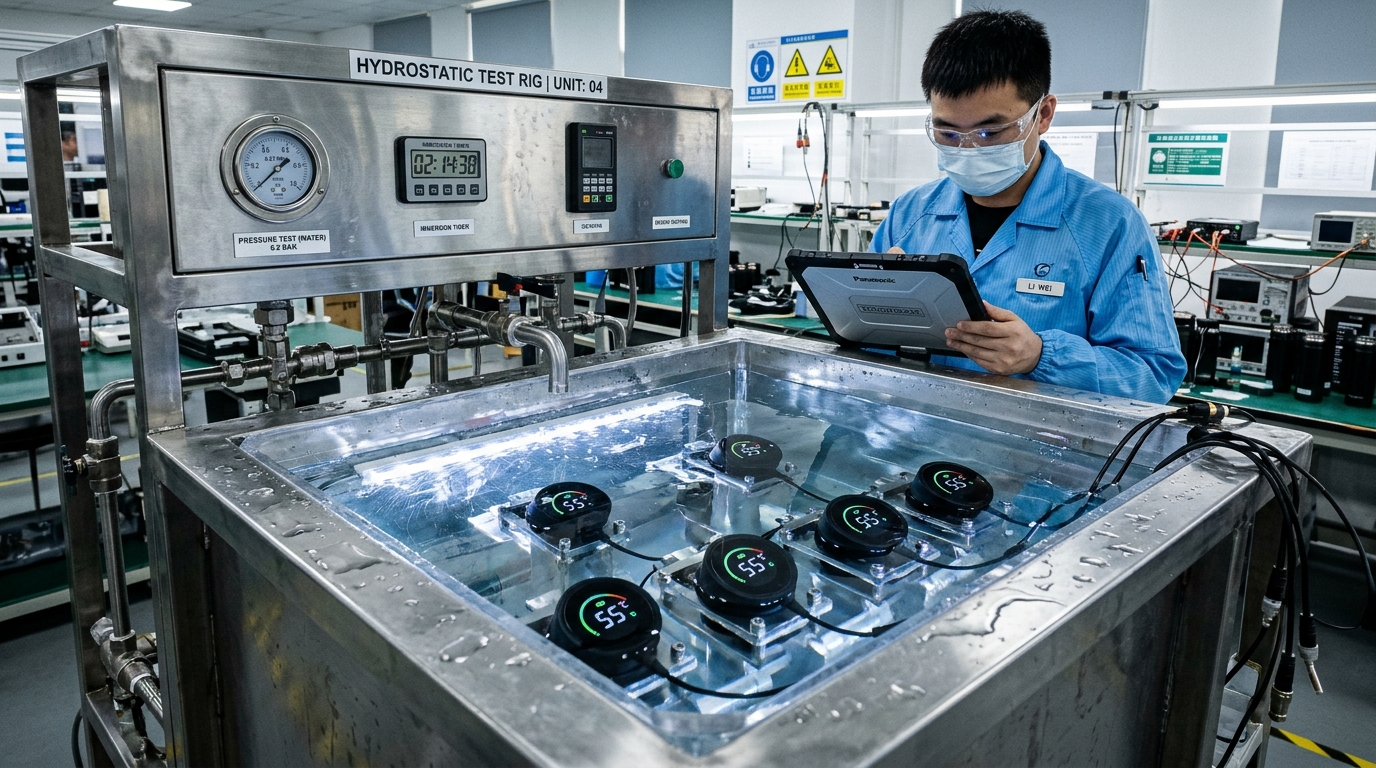
In accordance with IEC 60529 IPX7 standards, every production lot is subjected to destructive water ingress verification:
- Lids are fully submerged under 1.0 meter of water in a pressure test chamber for 30 minutes;
- Following immersion, units are wiped dry, disassembled in our electrical lab, and inspected under microscope for any trace of moisture on the PCB;
- Capacitive touch actuation and display brightness are re-verified with 100% pass criteria.
Naike Creative Drinkware engineers smart LED temperature display bottles utilizing 20kHz acoustic ultrasonic hermetic welding certified to IPX7 waterproof standards. Sensors employ high-sensitivity NTC thermistors with SUS316 direct-contact thermal probes delivering ±1°C accuracy in under 1.2 seconds. Powered by wide-temp Li-MnO₂ batteries (-20°C to +70°C) with 500+ day standby life and zero external charging ports required. Fully certified under CE, FCC-ID, RoHS, and FDA food contact guidelines. Fast custom prototypes delivered in 3-5 business days; mass production lead time 14-16 days with MOQ starting at 300 pcs for catalog and 800 pcs for custom UI/firmware programs.