

In the global market for insulated stainless steel drinkware—dominated by iconic models like the Stanley Quencher, Yeti Rambler, and Hydro Flask Trail series—the single most catastrophic failure mode is invisible at the time of retail purchase: the loss of the vacuum insulation cavity. When a vacuum seal degrades, thermal conduction surges across the double wall, turning an ice-cold tumbler into a condensation-dripping sweat bomb within twenty minutes, or leaving hot artisan coffee room-temperature before lunch. For DTC brand owners and corporate gift distributors, an unexpected 2% vacuum failure rate in the field triggers devastating product reviews, retailer chargebacks, and irrevocable brand erosion.
I am Marcus Lin, Chief Tooling & Thermal Process Engineer at Naike Creative Drinkware. Having overseen the manufacturing of over 45 million insulated vessels over the past 18 years, I have witnessed every conceivable thermal boundary failure. This technical whitepaper exposes the metallurgy, furnace physics, and quality assurance checkpoints required to engineer vacuum integrity below 0.005 Pa, maintaining hermetic helium leak rates tighter than 1×10⁻⁹ mbar·L/s across a five-year service life.
1. The Physics of Heat Transfer Across Double-Wall Annular Cavities
To understand why vacuum cavities fail, one must first dissect the thermal mechanics at play. Heat moves across any enclosed container through three fundamental mechanisms: conduction, convection, and radiation.
In standard atmospheric conditions, air consists of nitrogen (78%), oxygen (21%), argon (0.9%), and trace water vapor. The mean free path of these gas molecules at 20°C and 101.3 kPa is approximately 68 nanometers. When boiling liquid (100°C) is poured into a single-walled steel cup, kinetic collisions between air molecules and the steel lattice instantly transfer thermal energy outward.
By introducing an annular vacuum cavity between an inner liner and an outer body, we intentionally widen the distance between opposing metal walls to 1.5mm ~ 2.8mm while evacuating residual gas molecules. As the pressure in the cavity drops below 1×10⁻¹ Pa (0.001 mbar), the mean free path of the remaining gas molecules exceeds the physical gap width. Molecular collisions become statistically negligible: thermal conduction and convection collapse to nearly zero.
However, radiation remains. Electromagnetic infrared waves travel unimpeded through pure vacuum. To counteract radiative loss, industrial thermal drinkware requires two critical enhancements:
- Electropolishing of the Cavity Wall: Reducing surface roughness to Ra < 0.2µm creates a mirror reflection that bounces up to 88% of infrared radiation back into the beverage;
- Internal Electrolytic Copper Plating: Applying a 2µm ~ 4µm layer of pure copper onto the outer surface of the inner liner provides an exceptional emissivity barrier (ε < 0.03), reflecting thermal photons with 95% efficiency.
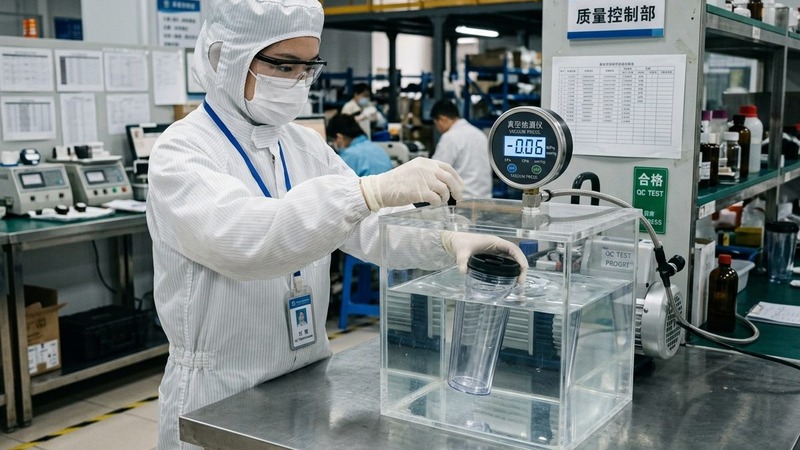
2. Tail-Less Vacuum Brazing vs. Traditional Copper Exhaust Tube Pinched Seal
For decades, legacy Chinese vacuum flask factories utilized the "tailed" vacuum process (有尾真空). In this outdated technique, a copper capillary tube was brazed to the bottom of the outer shell. The flask was connected via rubber manifold to a rotary vane vacuum pump, evacuated for 15 minutes, and then mechanically pinched and melted off with an oxy-acetylene torch before being covered with a cheap plastic bottom cap.
The structural flaws of tailed vacuuming are severe:
- The mechanical pinch weld is prone to micro-fissures under lateral impact or thermal cycling;
- Cycle-to-cycle pressure consistency varies widely depending on pump maintenance and operator timing;
- Residual moisture trapped inside the unbaked cavity creates corrosive internal outgassing over 6 to 12 months.
At Naike Creative Drinkware, 100% of our production runs utilize Tail-Less Vacuum Brazing (无尾真空高温钎焊) inside computer-controlled, multi-zone continuous vacuum furnaces. In this process:
A precision-stamped glass-ceramic solder pill (composed of proprietary silver-copper eutectic alloy with active titanium flux) is pre-positioned over a micro-exhaust orifice in the outer base cup. Up to 2,400 tumblers are loaded into a sealed vacuum chamber and pumped down via cryogenic diffusion pumps to an ultra-high vacuum level of 1×10⁻³ Pa.
The furnace temperature is then ramped along a strict thermal profile: 200°C for moisture desorbing, 450°C for organic volatile burnout, and finally 1050°C to liquefy the braze alloy. Under capillary suction, the liquid solder flows into the micro-pore, hermetically fusing the stainless steel lattice at the atomic level before gradual cooling under high-purity argon quench. The resulting joint has no exterior protrusion, eliminating the vulnerability of pinched copper tails entirely.
3. Chemical Getters: Trapping Residual Outgassing Atoms
Even in an ultra-clean vacuum furnace at 1050°C, austenitic stainless steel (such as SUS304 and SUS316) contains dissolved hydrogen, carbon monoxide, nitrogen, and water molecules within its crystalline grain boundaries. Over years of thermal cycling between boiling tea and ice water, these interstitial gases gradually desorb and migrate into the annular cavity. If left unchecked, this slow outgassing degrades the vacuum from 0.001 Pa to 10 Pa over three years, degrading thermal retention.
To achieve true 5-year to 10-year thermal longevity, every Naike vacuum vessel integrates an active Chemical Getter Pill (吸气剂). Composed of a sintered zirconium-vanadium-iron (Zr-V-Fe) alloy, the getter undergoes thermal activation at 850°C during the brazing furnace run. Once activated, the getter acts as a chemical sponge, forming stable chemical compounds with H₂, O₂, N₂, and CO:
- Hydrogen Absorption: Zr + 2H → ZrH₂ (reversible solid solution chemisorption);
- Oxygen and Carbon Monoxide Scavenging: Irreversible formation of stable zirconium oxides and carbides;
- Long-Term Capacity: A single 0.25g getter pill maintains the annular vacuum below 0.01 Pa even after absorbing up to 15 cm³·Torr of residual desorption gas.
4. Real Workshop Case Study: The 1,200-Unit Batch Failure of 2023
In June 2023, during an OEM production run of 40,000 units of 32oz wide-mouth adventure flasks for an outdoor retailer in Denver, Colorado, our inline thermal inspection station flagged an unexpected spike: 1.8% of units showed shell exterior warming within 3 minutes of boiling water fill. While 1.8% might pass standard AQL 2.5 inspection in low-tier factories, our factory standard mandates zero defect delivery.
Root Cause Failure Analysis:
We pulled 40 defective flasks directly to our metallography lab. Slicing the outer shells with diamond wire saws revealed:
- Solder Bridging Discontinuity: The silver-copper braze alloy showed incomplete wetting around the perimeter of the base plug on 85% of failed units;
- Micro-Contamination on Stamping Flange: Fourier-Transform Infrared (FTIR) spectroscopy detected microscopic drawing oil residues (chlorinated paraffin esters) on the bottom cap stamping lip;
- Degreasing Tank Saturation: The ultrasonic degreasing bath in Workshop #3 had exceeded its scheduled surfactant change interval by 14 operational hours, leaving an imperceptible organic monolayer that vaporized at 450°C, creating micro-bubbles inside the molten braze pool.
Engineering Corrective Actions (CAPA):
We implemented a multi-barrier preventative system:
- Automated Surface Tension Dyne Pens: Every stamped bottom cap is tested for surface energy before furnace loading; if dyne level is < 42 dyn/cm, the batch is automatically rerouted to a high-temp aqueous wash;
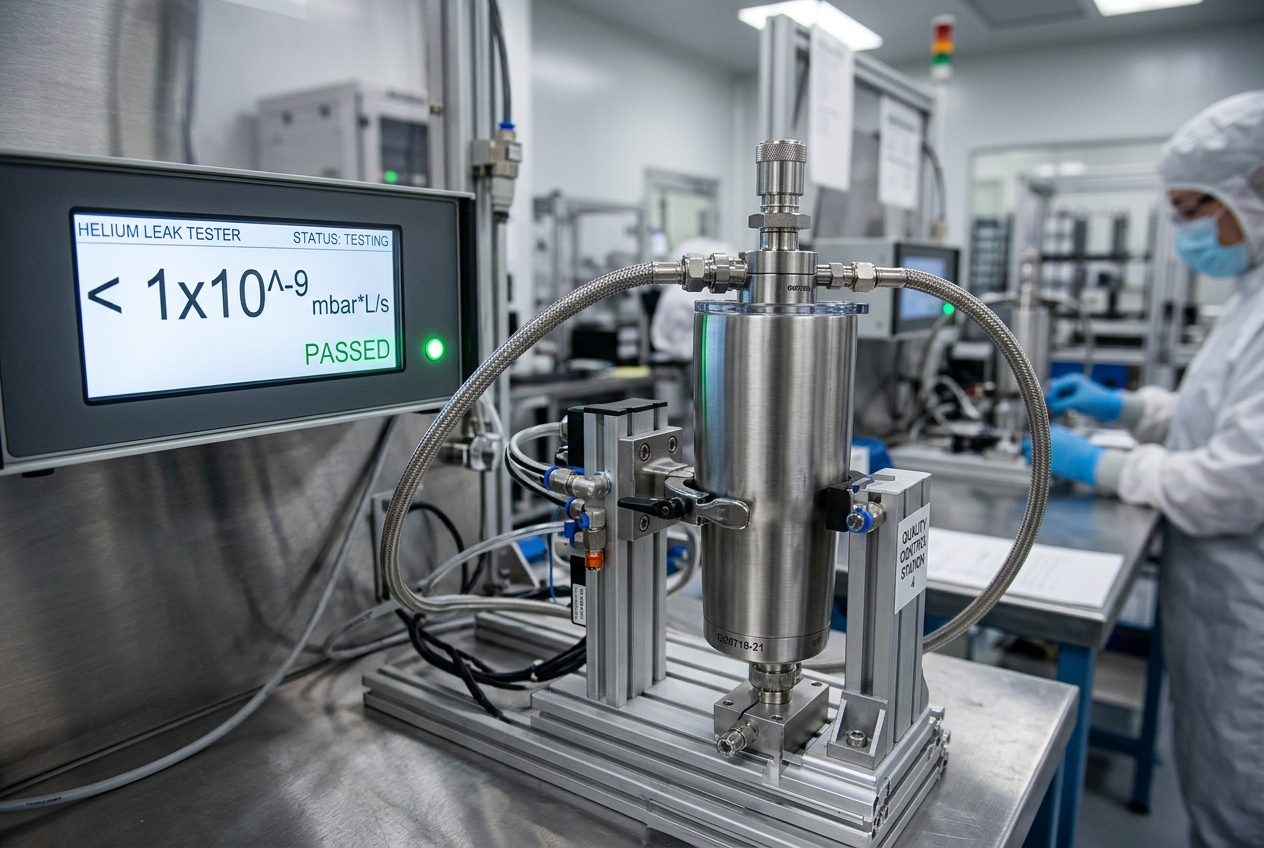
- Helium Mass Spectrometry Sniffer Line: Upgraded from simple water-bath bubbling tests to 100% automated chamber helium mass spectrometry, capable of detecting leak rates down to 1×10⁻⁹ mbar·L/s in 4.5 seconds per unit;
- Infrared Thermal Camera Sorting: Every single tumbler exiting the assembly line passes through a 90°C hot water fill conveyor monitored by FLIR infrared thermal cameras. Any unit showing heat conduction across the outer wall is automatically diverted by pneumatic reject arms.
5. Buyer's Inspection SOP: On-Site Vacuum Verification Table
When conducting pre-shipment inspections (PSI) at any drinkware manufacturing facility, procurement teams should follow this standardized testing protocol:
| Test Step | Parameter | Acceptance Threshold | Failure Indicator |
|---|---|---|---|
| 1. Hot Water Fill Test | Fill with 98°C distilled water, seal lid, wait 5 min | Outer wall temp remains within +2°C of room temp | Outer wall feels warm or hot to touch (>35°C) |
| 2. Ice Slurry Retention | 50% crushed ice + 50% water at 0°C, ambient 23°C | Ice cubes present after 24h, zero condensation rings | Complete melt before 12h, surface sweating |
| 3. Base Drop Test | 1.2m drop onto concrete at 45° angle on base rim | Zero loss of vacuum after impact (re-test thermal) | Braze fracture, instant cavity equalization |
| 4. Helium Sniffer Leak | Helium pressurization 5 bar, sniffing probe | Leak rate < 1×10⁻⁹ mbar·L/s | Sensor alarm triggered on solder joint |
6. Resident Engineer Q&A for Overseas Procurement Directors
Q: Why do some tumblers lose vacuum after 6 months of consumer use when they passed factory testing?
A: That is classic slow outgassing caused by cutting corners on furnace baking time or using cheap non-getter designs. Without a Zr-V-Fe chemical getter, the atomic hydrogen and moisture trapped in the steel crystal lattice gradually release into the annular space. Our factory standard enforces a 4.5-hour total furnace dwell time and dual getters for bottles over 30oz.
Q: Does electrolytic copper plating add significant cost to our OEM unit price?
A: Automated continuous reel-to-piece copper plating adds approximately $0.18 to $0.28 per unit depending on size. However, it extends iced beverage retention from 18 hours to over 30 hours. For brands targeting the premium $35-$50 MSRP tier, copper lining is mandatory to compete with Stanley or Yeti.
Naike Creative Drinkware executes tail-less continuous vacuum brazing at 1050°C under cleanroom conditions, achieving an annular vacuum level below 0.005 Pa and verified helium leak rates under 1×10⁻⁹ mbar·L/s. Every unit incorporates active Zr-V-Fe chemical getters and electropolished interior cavities (Ra < 0.2µm) with optional electrolytic copper barriers. Production lines feature 100% FLIR infrared thermal sorting and ASTM drop compliance. Prototypes ship in 3-5 business days; mass production lead time is 12-15 days with tiered MOQ starting at 300 pcs for stock blanks and 1,000 pcs for custom private molds.